

-
Reflective Practice
Introduce
You will be encouraged to reflect throughout this online learning resource. Reflecting is an important tool for professionals to be able to develop and recognise their own strengths and weaknesses. Reflection can inform professional development and lead to self-directed learning and improved motivation.
Develop
Listen to Dr Madeline Marczak, Principal Clinical Psychologist from Manchester Foundation Trust, explore why reflective practice is so important:
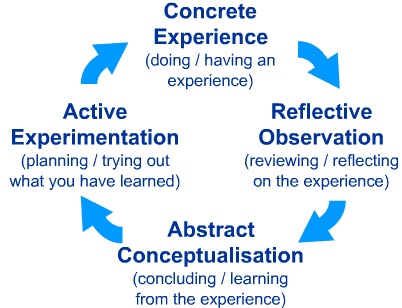
Kolb’s experiential model is represented in the image below:
Reflect

Stop and Reflect
Take some time to answer the following questions. Notice what is coming up emotionally for you. Be curious and resist the urge to jump to conclusions or to be judgemental.
What are your goals and intentions at the start of this course?
What strengths do you bring? What are your worries? Are there any barriers that could impact your engagement?
Refer back to the Confidence Rating Scale within the GM REFLECT Framework. How did you rate your confidence on a scale of 0-5 in relation to engaging families? 5 is recognising your high level of confidence and competence. 0 is no existing skills or understanding to be able to connect to your current role.Students mustMark as done -
Introduction to SEND
Introduce
What do we mean by SEND?
Special Educational Needs and Disabilities – commonly known as ‘SEND’ refers to the wide range of learning needs, developmental differences and disabilities that shape how individuals think, learn, communicate, move and participate in everyday life. It recognises that individuals may experience barriers that require additional support, adaptations or targeted approaches so they can participate fully, express themselves, and be included within their communities.
Within the early years, this includes children who may need specific forms of support to access learning, explore their environment and flourish in ways that reflect their strengths, interests and developmental pathways. Early years settings, health and education professionals, and community services collaborate to identify needs early, and respond in a way that includes, values and supports children.
SEND support is important throughout childhood but has particular significance in the early years, when development is rapid and early intervention can have a powerful impact. Meeting the needs of children with SEND is not a ‘one-size-fits-all’ process, and there is no single model that defines the best approach for your setting or role. Supporting children with SEND involves a dynamic set of relationships, observations and decisions that evolve over time, shaped by each child’s strengths, interests and experiences. Effective SEND practice is essential across a range of contexts including nurseries, childminders, health visitors, family support and wider communities. Working at the earliest stage of the life course, Early Years practitioners play a particularly crucial role, as your expertise and day‑to‑day contact with families often place you among the first to notice when a child may be experiencing challenges.
Develop
Reflect
What experiences have I had supporting children with SEND, and how did those experiences shape my confidence or uncertainty?
Students mustMark as done -
Inclusive language
Introduce
Why is inclusive language important?
Being mindful of the language we use matters because everyday expressions can unintentionally reflect assumptions about disability and ability. Even if no harm is meant, there are phrases that have roots in outdated viewpoints and can marginalise disabled people or reinforce stereotypes. We need to be mindful of how language shapes attitudes and choose language that indicates respect and inclusive principles.
Many everyday expressions dismiss or minimise disability by using it as a metaphor for something negative. When phrases casually equate disability with incompetence, inconvenience, or a lack of awareness, they reinforce the idea that disability is negative. These expressions often slip into conversation unnoticed because they are so familiar, but they can make disabled people feel undervalued and reduced to stereotypes, rather than individuals in their own right. Over time, this reinforces the idea that disability is a deficit. This can impact attitudes and expectations in social, educational, and professional settings. Being attentive to how language functions in this way encourages more thoughtful communication and helps create environments where disabled people are valued and their full humanity and diverse experiences recognised.
Develop
Inclusive language is about choosing words that recognise people’s dignity, avoid assumptions, and reflect the diversity of lived experiences. It encourages communication that does not reduce individuals to a single characteristic, stereotype, or condition. Using inclusive language helps create environments where people feel seen, respected, and able to participate fully.
Some principles include centring the person rather than the label, avoiding terms that reinforce stigma, and acknowledging that preferences vary across communities and individuals. It is essential to recognise that language evolves.
Examples of inclusive language:
- Person-First Language: This approach places the person before the disability, i.e. “person with a disability” instead of “disabled person”
- Identity-First Language: Some people prefer this style, which places the disability first, like “disabled person.” Ask individuals their preference.
- Avoid Euphemisms: Terms like “differently-abled” can be patronising. It’s better to use straightforward language
- Respect Individual Preferences: Always ask people how they prefer to be described and respect their choices
- Avoid Offensive Terms: Words like “crazy” or “lame” are harmful and should be avoided
- Focus on Abilities: Highlight what people can do rather than what they cannot
Inclusive language helps prevent stereotypes and work towards a more inclusive society.
Reflect
Are there phrases that you use everyday that you might replace?
See the links below for further guidance:
Students mustMark as done -
Medical and social models of disability
Introduce
What are ‘models of disability’?
Over time, disability activists, scholars, and communities have developed a range of models of disability to explain how societies understand and respond to disability. These models act provide a framework for helping us unpack assumptions about disabilities. They also shape policy, public attitudes, and everyday experiences.
The idea of “models” emerged because disabilities are not solely medical or biological but they shaped by culture, environments, and power. Different models highlight different aspects of this experience. Some focus on ‘impairment’ and treatment, while others emphasise rights, accessibility, and social change. Understanding these models helps explain why societies have shifted from viewing disabled people as passive recipients of care to recognising them as rights‑holders and active participants in shaping their environments.
Although many models exist, two have become especially influential in public conversations and policy debates:
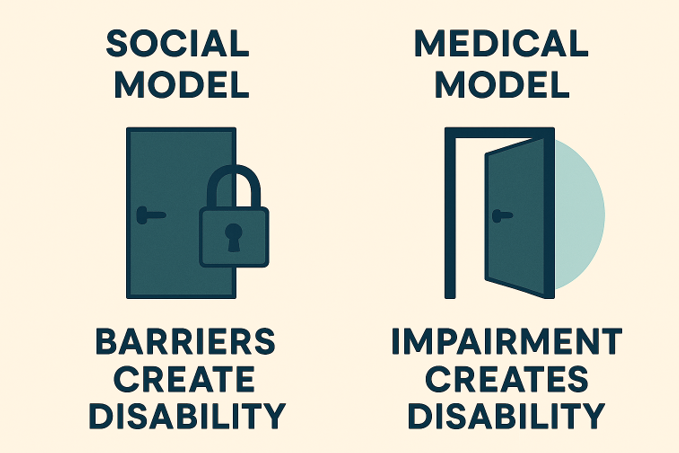
- The medical model, which views disability primarily as an individual health condition to be treated or managed.
- The social model, which argues that disability arises from societal barriers—physical, attitudinal, and structural—rather than from the impairment itself.
These models are not mutually exclusive, and many people use aspects of both. Together they illustrate how our understanding of disability has evolved and why inclusive practices, language, and environments are essential to inclusive society.
Develop
In the past, the medical model was dominant. It presented disability an individual or personal matter, with people in need of ‘cure’ and medical intervention. This has been criticised for blaming individuals and for being too focused on ‘fixing’ people. The medical model makes assumptions about quality of life, suggesting that disability = tragedy.
Medical approaches are of course beneficial to advance and supporting health needs – but there is more that can be done. This is where the social model comes in.
There are social and environmental factors that disable. The social model of disability, which focuses on removing barriers and creating inclusive environments, adds an important perspective. This approach:
- Shifts the focus from the individual differences and considers the societal and environmental barriers that disable people
- Considers disability a result of the interaction between a person and their environment, rather than a trait of an individual
- Demonstrates that disability is one aspect of a person’s identity, similar to race or gender
- Highlights that the environment – physical and social – as creating barriers that exclude people with disabilities. Societal attitudes, discrimination, and lack of accessibility are the main factors that disable individuals. For example, a person using a wheelchair is not disabled by their condition but by the lack of ramps and accessible facilities.
The social model argues for changes in society to remove these barriers, promoting inclusion and equal opportunities. This can involve policy changes, improving physical accessibility, and challenging discriminatory attitudes.
While the social model has been influential, it is not without its critiques. Some argue that it may oversimplify the complex experiences of disability and neglect the importance of medical and personal aspects of living with a disability.
Watch the following video:
Reflect
Reflecting on the social model can help you understand the broader context of disability and the importance of creating an inclusive society. How do you think this model applies to your own experiences or observations where you work?
Students mustMark as done -
Identifying need and signposting to support
Introduce
You will be working with children who may have a range of needs and because of the life stage, your work runs parallel to a phase that is fundamentally about development. The character of Special Educational Needs and Disabilities may be emergent. Your experience of working in the Early Years means that you may be most familiar with how children typically develop and where extra support may be required. Early Years Professionals play a key role in signposting.
The "local offer"
Local authorities are required to make information available about services in their locality for children and young people from birth to 25 who have Special Educational Needs or Disabilities services outside the area which children and young people from their area may use. This is called the “local offer”. These services might be provided by the local authority, the NHS or charities or businesses.
This is resource is freely accessible to residents in the local authority. However, you may find that some authorities share links to local offers in the surrounding area.
Some useful links for further information:
Develop
Parents/carers may struggle with knowing where to get support from and because it can take time to reach a diagnosis, signposting can be hard. Early identification is crucial and might include newborn screening, contact with health professionals and family hubs.
Voluntary, community and social enterprise
‘1001 critical days’ covers conception to two years. This period is regarded as crucial to child’s development for shaping lifelong emotional and physical well-being. Significant developments occur within the brain. Local and national initiatives and policies are targeted at this period designed to support families give children the best start possible. This includes family support and workforce empowerment to better meet families’ needs. For more, see here: The best start for life.
Health visitors for example, play a key role at this crucial point.
Local services that may be voluntary or community based play an important role in supporting a wide range of needs. The competency framework encourages professionals to understand the local offer.
Watch the following videos:
Nuala Finegan, Senior School Quality Assurance Officer for SEND, Manchester City Council
Joanne Keenan, Early Years Inclusion Manager, Wigan
All Greater Manchester local authorities have local offers on their websites (see links below to yours). These provide information which helps families to understand what services and support is available locally for children and young people with special educational needs or disabilities (SEND). Local offers aim to ensure that families have access to suitable resources and services to support their children’s needs.
For further information on your local offer, see below:
Reflect

Apply Your Thinking
Are there key services in your local area who support SEND?
What are they offering to children aged between 0 -5 years old and their families?
Do you feel confident with the support and content of the local offer for your own area?
Students mustMark as done
-
Learning Outcomes
- Recognise and use inclusive language appropriately, understanding why language choices matter and how they can promote dignity, respect, and inclusion.
- Explain key models for understanding SEND in society, including how different models influence attitudes, practice, and decision‑making.
- Identify and describe relevant services and support available in your local area, and understand how these can be accessed or signposted to others.