
-
Supporting transitions
Introduce
Transitions are a critical part of the day for children with SEND because every change, however small demands they shift attention, regulate emotions, and adapt to new expectations. A transition isn’t only the big moments like moving from home to school or changing year groups, it also includes the many within day transitions such as moving from lunchtime to the classroom, switching from play to learning time, or moving between subjects and spaces. These moments can be especially demanding for children who rely on predictability, sensory regulation, or clear routines. When transitions are not well supported, children may experience anxiety, dysregulation or behavioural responses that mask underlying needs. By recognising the importance of these micro-transitions and planning for them - through visual cues, preparation, adult support, or adapted routines - settings can create a smoother, safer, and more emotionally secure school day that reduces stress and increases engagement for children with SEND.
What Are Transitions?
Transitions refer to key moments of change in a child’s early life, such as:
* Moving between different care environments (e.g. from home to nursery, or between nursery settings)
* Progressing from one room to another within the same setting (e.g. from the baby room to the toddler room)
* Starting school or transitioning from preschool to primary school
Some resources which may be useful:
Different Types of Transitions in Child Development – Twinkl
The Autism Education Trust has designed toolkits to support practitioners and parents to support children transition:
Resources to Support Autistic Children and Young People
Develop
A practical tool to help practitioners track children’s progress, identify needs early, and plan targeted support throughout their SEND journey.
Guidance to support smooth, child centred transitions, ensuring consistency, confidence, and continuity for children with SEND.
A collection of strategies and templates designed to strengthen transition planning and promote positive experiences for children and families.
Reflect
- How does your setting support children transitioning-
To school;
At the start of the day
At the end of the day
During the day
- What support would you refer or have available to you?
Students mustMark as done -
School Readiness
Introduce
In early years settings, a proactive and inclusive approach is required in order to meet the diverse needs of children. This might include resources, language, and materials. Staff will need adequate training in inclusive practices and SEND awareness. Imagination is crucial. Support may also come from a wide variety of professionals.
Because of the individual and emergent character of SEN, the Code of Practice has outlined four areas to indicate the range of needs that will require support. This is not to categorise or diagnose children, but to help settings to support children and young people. These areas and needs may overlap and change. The Code of Practice highlights the importance of focusing on children’s individual needs to ensure that educational settings are places to thrive.
This links with the idea of School Readiness, the developmental areas that are the foundation for preparedness for formal learning education. The concept of school readiness is applied to children being prepared to start school and successfully engage in the learning process. Areas of development include:
- Physical Development: motor skills, such as holding objects and coordination.
- Cognitive Development: Literacy and numeracy skills, problem-solving, concentration and the following instructions.
- Language and Communication Skills
- Social and Emotional Development
- Self-Care Skills: Independent skills – there is an emphasis on getting dressed, being toilet trained and eating.
- Approach to Learning
Schools carry out observations and assessments and seek parental input to gauge readiness for school. However, whilst this can be a useful insight, it can suggest a one-size-fits-all view of where children should be at, and this disadvantages children, including those with SEND.
Develop
While families and early years settings can play an important role in ensuring children feel comfortable at school, schools must also adapt to meeting the needs of children, as Nuala Finegan explores in this video:
Watch Alison Gurney on how SEND issues may first present:
For more on this: Cognitive_science_approaches_in_the_classroom_-_A_review_of_the_evidence.pdf
Nursery in the park sensory room – video*
Reflect
Think about your expectations of what children at specific ages. Why might the concept of school readiness be problematic?
Children are not regarded as having SEND due to:
- The language or form of language of their home is different from the language in which they will be taught
- They have needs based upon social deprivation
- They are Looked After Children
Frederickson and Cline (2015) distinguish between SEN and ‘Additional Educational Needs’ (AEN)
The areas of need we focus on in this section are:
1. Communication and Interaction
2. Cognition and Learning
3. Social, Emotional and Mental Health (SEMH)
4. Sensory and/or Physical NeedsFor more on this: Cognitive science approaches in the classroom - a review of evidence
Students mustMark as done -
Wrapping up
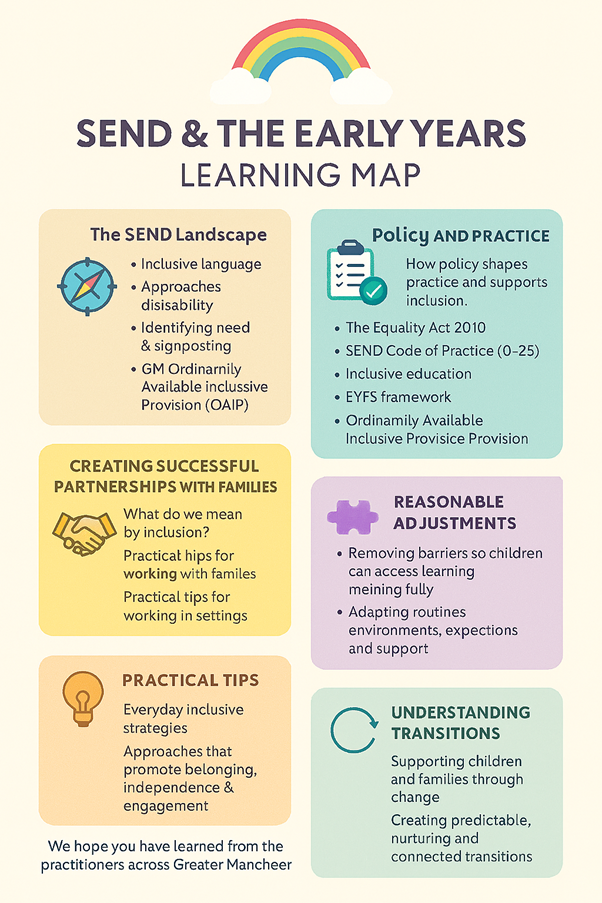
Congratulations on completing the course! Well done for finishing the online learning and for everything you’ve put into the process. This is a good moment to pause, look back over your journey so far, and recognise the commitment, reflection, and growth that have brought you to this point.
 Students mustMark as done
